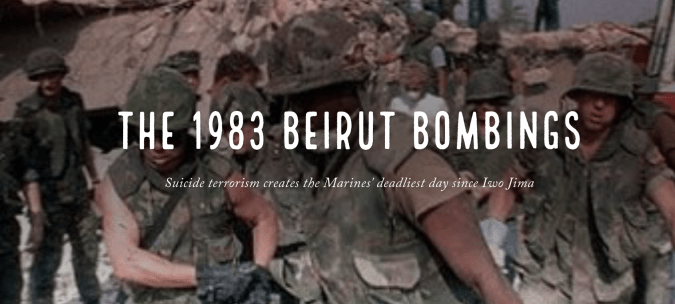
“[I found] myself engulfed in a dense gray fog of ash,” [Colonel Tim Geraghty] recalled, “with debris still raining down.” His logistics officer, Major Bob Melton, then motioned to Geraghty and gasped, “My God, the BLT [Battalion Landing Team] building is gone!”
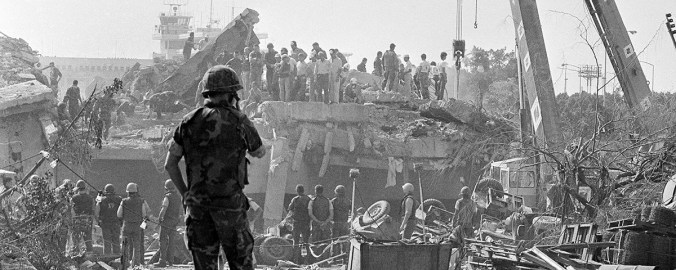
‘Hours after the Sunday, Oct. 23, 1983, bombing of the Marine barracks in Beirut, rescuers comb the wreckage for the wounded and dead.’ AP Photo/ Zouki
“In the early hours of October 23, 1983, a young Lebanese man from a Shi’a family awoke, said his morning prayers, and drank tea. In a suburb overlooking the Marine barracks, his superiors shared a few final thoughts with him, after which a senior cleric blessed him before he drove off in a yellow Mercedes truck. At 6:22 a.m., he rammed the explosive-laden truck through the guard post at the entrance to the U.S. Marine Battalion Headquarters Building in Beirut. The blast decimated the four-story, concrete, steel- reinforced structure—considered one of the strongest buildings in Lebanon at the time. A dense, gray ash cloud engulfed the area as emergency vehicles rushed to the scene. Those soldiers lucky enough to escape serious injury quickly mobilized to rescue their fellow Marines, sifting through “dust-covered body parts, moaning wounded and dazed survivors.” Seconds later, a nearly identical attack targeted the French Multinational Force (MNF) building less than four miles away.”
-Matthew Levitt, “The Origins of Hezbollah”
Background
The Lebanese Civil War had already been raging for seven years when the Multi-National Force comprising 800 Americans (mostly Marines of the 32nd Marine Amphibious Unit, or MAU), 800 French, and 400 Italian peace-keepers landed in Beirut on 25 August, 1982. The-peace keepers were there to assist in the evacuation of the PLO, the Palestinian Liberation Organization, from Beirut, thereby (hopefully) preventing further violence.
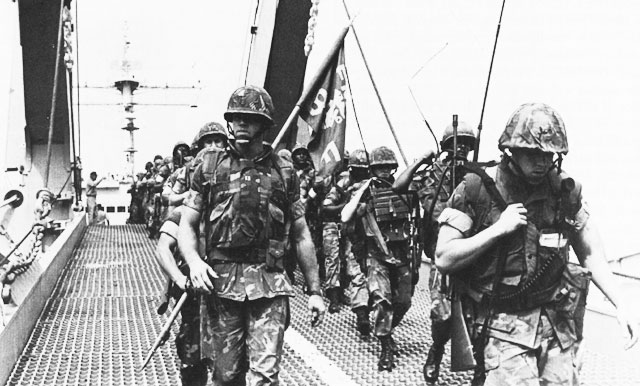
Capt Richard C. Zilmer leads his Company F, Battalion Landing Team 2/8 Marines ashore from the landing ship Saginaw (LST 1188) at the port of Beirut on 29 September 1982. US Navy Photo.
President Reagan sent a message to the Marines of the 32nd MAU on August 24th, 1982, as they prepared to embark onto their landing craft:
“You are about to embark on a mission of great importance to our nation and the free world. The conditions under which you carry out your vital assignment are, I know, demanding and potentially dangerous. You are tasked to be once again what Marines have been for more than 200 years–peace-makers.
Your role in the Multinational Force–along with that of your French and Italian counterparts–is crucial to achieving the peace that is so desperately needed in this long-tortured city.”
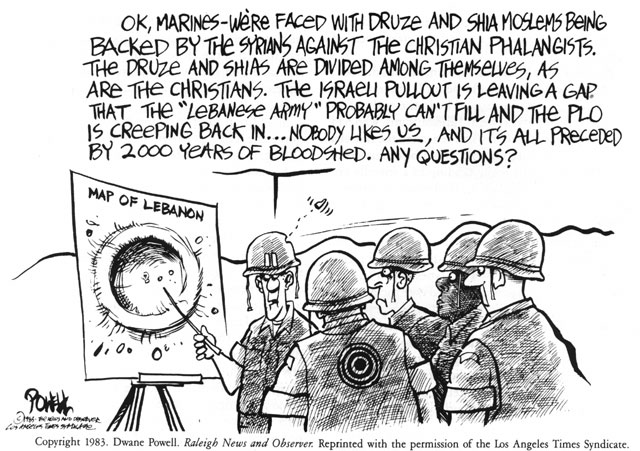
The military situation on the ground was confused and extremely fluid; Christians, Druze, Shi’a, Sunnis, Israelis, Syrians, and Lebanese had been fighting in the suburbs and surroundings of Beirut for years. One cartoonist of the period, Dwane Powell of the Raleigh News and Observer, captured it as well as probably anyone else could have:
The evacuation of the PLO was successfully completed, and by 10 September, President Reagan withdrew the leathernecks of the 32nd Marine Amphibious Unit from Beirut.
Four days after the Marines withdrew, the President of Lebanon, Bachir Gemayel, was assassinated by a Lebanese member of the Syrian Socialist Nationalist Party. Running street battles between militias of all stripes were punctuated by massacres in retaliation for the assassination of Gemayel, most notably at the Sabra and Shatila refugee camps, where thousands were killed by Phalangist militias.
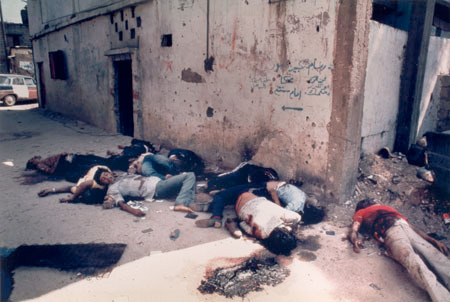
Sabra Refugee Camp Massacre. World Press Photo Winner, 1982. Robin Moyer, Time Magazine
The Marines were back in Beirut by the end of September, 1982. On April 18, 1983, the United States Embassy in Beirut was bombed, in an eerie prequel to what the Marines would experience: A truck drove up to the front of the building, packed with approximately 2,000 lbs of TNT, and detonated – with the driver still inside. 63 people, including 17 Americans, were killed in the blast. A group calling itself Islamic Jihad claimed responsibility. The U.S. Ambassador believed, rightly as it turned out, that the true perpetrators were Hezbollah – an Iranian proxy militia and terror organization in Lebanon. The size of the MNF was nearly doubled in response.
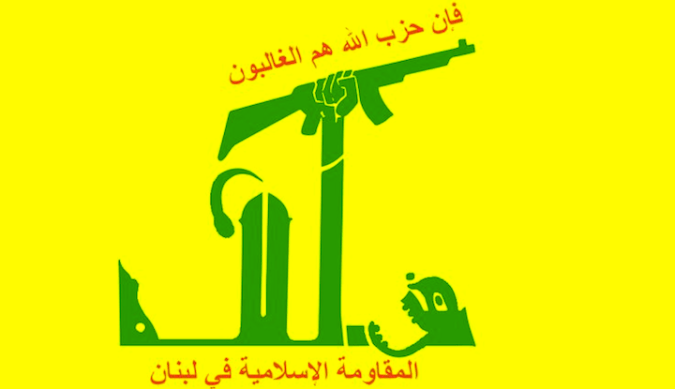
The flag of Hezbollah: حزب الله ḥizbu-llāh (meaning “Party of Allah”); Underneath the logo are the words المقاومة الإسلامية في لبنان al-muqāwamah al-islāmīyah fī lubnān, meaning “The Islamic Resistance in Lebanon”. (Wikimedia Commons)
Ambassador Dillon later wrote: “Hezbollah had Iranian support. It was simply a blow at the most visible symbol of American presence. It was during the time when the car bomb had become very common; it was not, however, the suicide car bomb, but just cars that were loaded with explosives and left in the streets. A deserted car became an object of great suspicion.
We had cleared the area around the embassy; cars were not allowed to park around the embassy, because of the possibility of a car bomb. The suicide car bomber was something new.” (4)
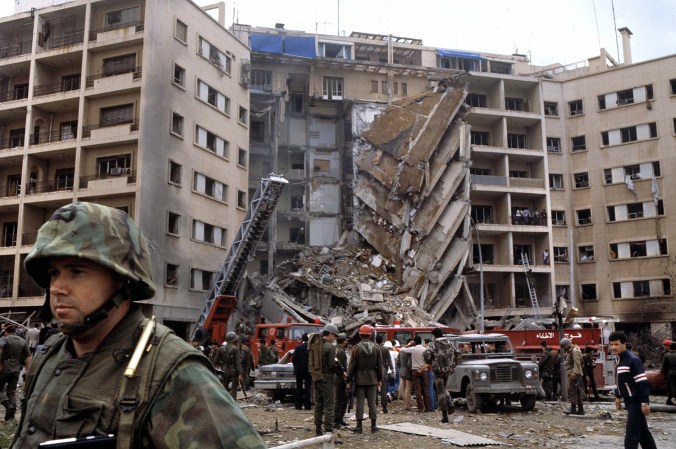
U.S. Embassy bombed in Beirut in April, 1983. Francoise De Mulder / Roger Viollet / Getty
In May of 1983, the Marines of the 32nd MAU were replaced by the Marines of the 24th MAU, including the Battalion Landing Team of 1st Battalion, 8th Marine Regiment (1/8), based out of Camp LeJeune, North Carolina.
For months, the Marines of the 24th MAU suffered a steady stream of mortar and rocket attacks, both while on patrol and while inside their base, at the Beirut International Airport. Between July to September 22nd, five Marines were wounded in rocket and mortar attacks on the airport, and three others killed. On October 19th, 1983, four Marines were wounded by an improvised explosive device (IED) that detonated while they were patrolling the city in a vehicle convoy (5).
The situation was not exactly stable, nor was peace on the horizon. The Marines hunkered down in their base at the Airport, battening down the hatches as they prepared to weather the storm.
Hezbollah
“Americans sometimes engage in suicidal attacks, but not in suicide attacks. A suicidal attack is one which is understood that chances of survival are not very good. The suicide attack on the other hand is one in which one’s willingness to die is the attack itself. That is an important distinction.” -Robert Dillon, U.S. Ambassador to Lebanon (4)
The group ultimately responsible for the Embassy attack, and who would retroactively be ascribed responsibility for the bombings of the barracks at the Beirut International Airport, was formed in the crucible of the Israeli occupation of Lebanon, beginning in 1982. Iranian money and operatives gathered together a diverse group of Shi’a militias operating in the countryside and in Beirut, with the aim of repelling the Israelis. When the U.S., French and Italian peace-keepers landed in the fall of 1982, the group added new enemies and targets to it’s list.
Adam Shatz in The New York Review of Books describes the early years of the group: “Militant followers of the Ayatollah Khomeini, Hezbollah’s original cadres were organized and trained by a 1,500-member contingent of Iran’s Revolutionary Guards, who arrived in Lebanon’s Bekaa Valley in the summer of 1982, with the permission of the Syrian government.
For Iran, whose efforts to spread the Islamic revolution to the Arab world had been stymied by its war with Iraq, Hezbollah provided a means of gaining a foothold in Middle East politics… in their discipline and willingness to die for their cause they had few rivals, as the world was to discover the following year, when members of the clandestine “Islamic Resistance” (a precursor to Hezbollah, which did not yet officially exist) launched a series of terrifying suicide attacks in Lebanon against American, French, and Israeli targets.” (7)
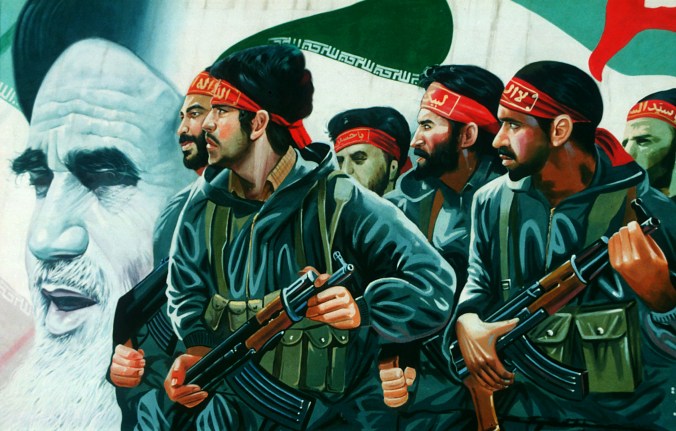
A mural in Tehran depicting Ayatollah Ruhollah Khomeini and Iranian soldiers. Photo: Neil Hester/flickr
Overall responsibility for both the Embassy and barracks bombings lies with Hezbollah, who, according to David Faoud, “recently boasted about its responsibility for the attack[s] in a nasheed (acapella song) it produced to commemorate the slain Jihad Mughniyeh, son of Hezbollah’s terrorist mastermind Imad Mughniyeh. The song included the lyrics, ‘I am Jihad, son of the hero, who led columns of the defiant; the one who felled elite soldiers, marines, and well-armed armies'” (8).
As a proxy of the Revolutionary Government of Iran, trained from its earliest days by the Islamic Revolutionary Guard Corps (IRGC), the Lebanese (predominantly Shi’a) members of Hezbollah have always had a distinctly Iranian approach towards tactics; including the early adoption of suicide bombings and attacks, or “istishad” (Arabic: استشهاد, “martyrdom” or “heroic death”).
Since the earliest days of the Iran-Iraq War (1980-1988), the Iranian regime had depended on, and encouraged, suicide attackers. As the prominent Iranian cleric, Mohammad-Taqi Mesbah-Yazdi, the unofficial leader of the Front of Islamic Revolution Stability, has written: “For sure, when protecting Islam and the Muslim Ummah depends on martyrdom operations, it not only is allowed, but even is an obligation (wajib) as many of the Shi’ah great scholars and Maraje’, including Ayatullah Safi Golpayegani and Ayatullah Fazel Lankarani, have clearly announced in their fatwas. Consider the rewayah from the prophet of Allah (SA) who said: “Whoever is killed in defence of his belongings, he/she is Shahid [martyr]” (9). Hezbollah, it seems safe to assume, picked up the tactic of suicide attacks from their Iranian IRGC trainers.
In the aftermath of the Embassy bombing of April, CIA reports concluded that “an overwhelming body of circumstantial evidence points to the Hizb Allah, operating with Iranian support under the cover name of Islamic Jihad.” A pattern was emerging, and it seemed likely that there was no coincidence that, since the entrance of the Iranian operatives in the summer of 1982, suicide vehicle borne improvised explosive devices (SVBIEDs) were suddenly a factor in the conflict in Lebanon. According to Levitt, “the CIA added at the time, ‘Shia fundamentalists are the only organized terrorists in Lebanon likely to willingly sacrifice their lives in such an attack'” (6).
The willingness of the Lebanese attackers, trained by Iranian IRGC operatives to use suicide tactics, would be brought to ghastly fruition on the morning of October 23rd, 1983.
The Attack
Because of the peace-keeping nature of the mission of the MNF, the Marines of the 24th MAU included, the rules of engagement were particularly stringent. All Marines were issued a “White Card,” detailing what they could and could not do. It began:
“When on post, mobile or foot patrol, keep a loaded magazine in the weapon, weapons will be on safe, with no rounds in the chamber. – Do not chamber a round unless instructed to do so by a commissioned officer unless you must act in immediate self-defense where deadly force is authorized. – Keep ammunition for crew-served weapons readily available but not loaded in the weapon. Weapons will be on safe at all times (2).”
The yellow Mercedes truck entered the Airport parking lot and circled twice. There was nothing unusual about heavy vehicles attempting to access the compound. The Marines had most of their supplies delivered, and the airport was an area of frequent traffic.
When the vehicle suddenly accelerated, the Marines on post were unprepared, due to the restrictions on their weapons.
“He looked right at me…smiled, that’s it. Soon as I saw [the truck] over here, I knew what was going to happen.” -Marine Lance Corporal Eddie DiFranco (1)
DiFranco, standing post that day, barely had time to load a magazine into his M16, and by the time he had chambered a round, the truck was past. It accelerated through the open gates and barreled towards the Battalion Landing Team (BLT) Barracks. DiFranco never got off a shot.
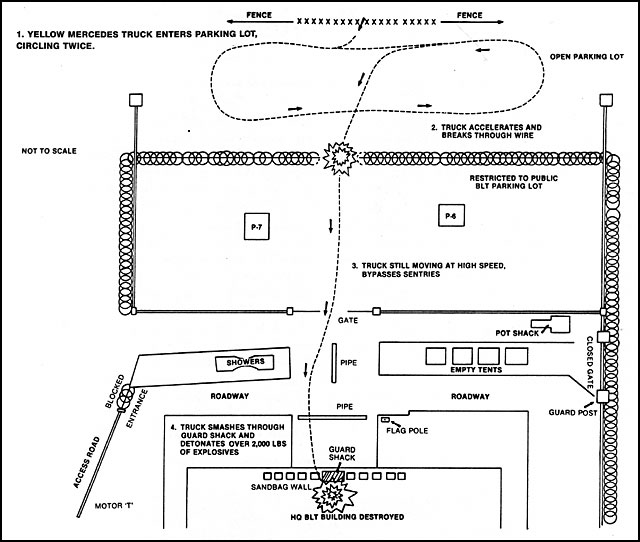
Sketch map of the route taken by the suicide bomber on the morning of October 23, 1983. [From the Long Commission Report]. (Wikimedia Commons)
“Bodies and pieces of bodies were everywhere. Screams of those injured or trapped were barely audible at first, as our minds struggled to grapple with the reality before us.” -Rabbi Arnold Resnicoff, Asst. Chaplain, U.S. 6th Fleet (1)
The bomb was “so powerful that it lifted the building in the air, shearing off its steel-reinforced concrete support columns (each 15 feet in circumference) and collapsing the structure (1),” killing 220 Marines, 18 Sailors and 3 US Army personnel. It was the United States Marine Corps’ single greatest loss of life in a single attack since the battle of Iwo Jima, in World War II, and still holds that tragic honor.
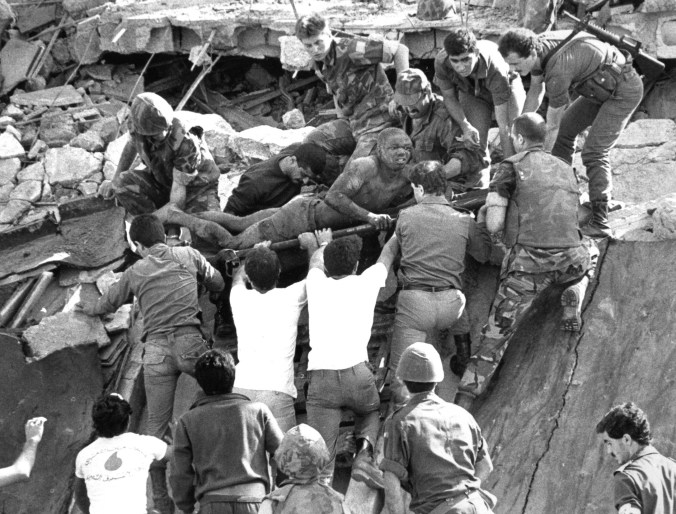
Rescue workers and volunteers assist survivors from the wreckage of the BLT Building. Bill Foley/ AP Photo
Just minutes later, a similar attack targeted the building which was serving as billeting for the 3rd Company of France’s 1st Parachute Chasseur Regiment, a few short miles to the north. The guards there, on alert from the massive smoke clouds and sounds of the previous explosion, managed to shoot the driver of the second SVBIED, but not before he detonated the explosives in his truck, destroying much of the building and killing 58 French Paratroopers… “many of whom had been standing on outside balconies, trying to discern what had occurred at the U.S. base just down the coast” (1).
The Aftermath
“FBI forensic investigators determined that the marine barracks bombing was not only the deadliest terrorist attack then to have targeted Americans, it was also the single-largest non-nuclear explosion on earth since World War II. Composed of at least 18,000 pounds of explosives— the equivalent of six tons of dynamite— the bomb demolished the four-story building on the fringe of the Beirut Airport campus, leaving behind a crater at least 13 feet deep and 30 feet wide. So many marines, sailors, and soldiers perished that day that the base ran out of body bags. At the French MNF building, the deaths of 58 French paratroopers marked the French military’s highest death toll since the Algerian war ended in 1962. The eight-story building where the paratroopers were staying was literally upended by the blast.” (6)
Due to the fact that Hezbollah was not yet an officially recognized organization, and its cutout, Islamic Jihad, could not be traced, the Iranians could not be held accountable. Their proxy strategy had worked. They had struck the Great Satan a disastrous blow, and in the upcoming years, their proxy Hezbollah would grow to dominate Lebanese politics. Though Islamic Jihad ultimately claimed responsibility, Hezbollah and Iran got away with it for years.
The Marines were ordered to withdraw on February 7th, 1984. Though retaliatory naval and aerial bombardments continued for weeks after, the American and MNF intervention in Lebanon was effectively over. Hezbollah, and its sponsor Iran, had won.
The Commission ordered by the Department of Defense was left to draw conclusions from the horrific loss of life. Admiral Long’s team wrote that “while it may have appeared to be an appropriate response to the indirect fire being received, the decision to billet approximately one-quarter of the BLT in a single structure contributed to the catastrophic loss of life…” (2)
In addition, they believed that it was a problem to “emphasize safety over security in directing that sentries on Posts 4, 5, 6, and 7 would not load their weapons. (2)” Had Lance Corporal DiFranco and his fellow guards had chambered weapons, significant loss of life might have been averted.
It was not until 2003 that Iran was held accountable for the bombings. A Federal Judge in Washington wrote that the “approval of both the Ayatollah [Ruhollah] Khomeini and President [Ali Akbar Hashemi] Rafsanjani was absolutely necessary to carry out the continuing economic commitment of Iran to Hezbollah, and to execute the Oct. 23 attack” (10).
Lessons
Americans had not been the victims of large scale terror on behalf of Islamic jihadis before the attacks in Beirut in 1983. The experience would prove to be eye-opening and tragic. Hundreds of Americans were dead, and the government had little to show for it. Consequently, American arms continued to flow to Iraq in it’s war against the Revolutionary Government in Iran. America’s support of Israel was further retrenched.
The military took many of the recommendations of the Long Commission. Recognizing the risk of SVBIEDs, military bases and federal buildings began to install concrete protective structures around buildings, and to push guardhouses, with guards with Condition 1 (round in the chamber) weapons, out to the perimeters.
At the larger level, however, the government and the military have still not learned how to deal with proxies, insurgencies and terror groups. The wars in Iraq and Afghanistan, and many other places, continue to bear testament to that fact, as Islamic jihadists worldwide continue to prosecute attacks and kill US troops. Policy makers, and the military as well, continue to under-estimate the tactical proficiency of non-state actors, even as they conflate the strategic threat such groups pose.
The true lesson we must take from this is to never become complacent. Tactics and technologies will continue to evolve, and if we fail to adapt, we will blind-sided like the Marines were in 1983, and Americans will die. Our job is to honor the sacrifices of those who died in the attacks of October 23rd, and to learn from them.
Bibliography:
(1) Ernsberger, Richard Jr. ‘1983 Beirut Barracks Bombing: “The BLT Building is Gone!”‘ History Net. http://www.historynet.com/1983-beirut-bombing-the-blt-building-is-gone.htm 27 October 2016
(2) Admiral Robert L.J.Long, USN, (Ret), Chairman; the Honorable Robert J. Murray; Lieutenant General Lawrence F. Snowden, USMC, (Ret), Lieutenant General Eugene F. Tighe, Jr, USAF, (Ret), Lieutenant General Joseph T. Palastra, Jr., USA.“Report of the DOD Commission on Beirut International Airport Terrorist Act, October 23, 1983.” Department of Defense. https://fas.org/irp/threat/beirut-1983.pdf 20 December 1983
(3) Frank, Benis M. “US Marines in Lebanon, 1982-1984” History and Museums Division, Headquarters, U.S. Marine Corps, Washington, D.C. http://www.ibiblio.org/hyperwar/AMH/XX/MidEast/Lebanon-1982-1984/USMC-Lebanon82/USMC-Lebanon82-1.html 1987
(4) Ambassador Dillon, Robert S. “The Bombing of U.S. Embassy Beirut — April 18, 1983” Association for Diplomatic Studies and Training. http://adst.org/2013/04/the-bombing-of-u-s-embassy-beirut-april-18-1983/#.WePttluPKM8
(5) Koff, David. “Chronology of the War in Lebanon, September – November 1983″ Journal of Palestine Studies, Volume 13, No. 2 (Winter, 1984). University of California Press. http://jstor.org/stable/2536907 1984
(6) Levitt, Matthew. “The Origins of Hezbollah” The Atlantic.https://www.theatlantic.com/international/archive/2013/10/the-origins-of-hezbollah/280809/ 23 October, 2013
(7) Shatz, Adam. “In Search of Hezbollah” The New York Review of Books.https://web.archive.org/web/20060822195222/http://www.nybooks.com/articles/17060 The New York Review of Books, Volume 51, Number 7. 29 April 2004
(8) Daoud, David. “Meet the Proxies: How Iran Spreads Its Empire through Terrorist Militias” The Tower. http://www.thetower.org/article/meet-the-proxies-how-iran-spreads-its-empire-through-terrorist-militias/ The Tower, Issue 24. March 2015
(9) Imam Mezbah-Yazdi, Mohammad-Taqi. “Martyrdom Operations” Mezbah-Yazdi.Org http://www.mesbahyazdi.org/english/contact-us/afq/contact4.htm#عمليات%20شهادت%20طلبانه
(10) Lengel, Allan. “Judge: Iran Behind ’83 Beirut Bombing” The Washington Post.https://www.washingtonpost.com/archive/politics/2003/05/31/judge-iran-behind-83-beirut-bombing/b4e3c60e-2921-45fa-a9fd-a1c48ce81e44/?utm_term=.fd699374dd55 31 May 2003
 Twilit Empire