The traditional Republican foreign policy position, all the way back to the end of WWII, has been to view Russia as America’s main geopolitical competitor (or other variations of that thought, such as “foe,” “threat,” and “enemy”). The exact categorization is hazy, because that role has shifted meaningfully many times since 1945. Be that as it may, the party orthodoxy, and the official American posture in general , has been to treat Russia as an actor on the world stage generally working at cross-purposes to us.
The fact that certain prominent Republican national security figures, as well as the Republican President-elect, seem much cozier than usual with Russia, is both confusing and alarming to many people; including Senators John McCain and Lindsey Graham – both Republicans who sit on the Senate Committee on Armed Services. Even the National Review, once vociferously anti-Russian, has surrendered to Putin, and disowned the findings of the intelligence community to cede the field on possible Russian interference in the recent election. Particularly, rank and file Republican voters have started to warm up to the Kremlin, with Vladimir Putin being viewed more favorably than Barack Obama.
Peter Beinart in The Atlantic writes: “Donald Trump is remaking Republican foreign policy in two fundamental ways. The first concerns Russia. Previous GOP leaders like Mitt Romney and John McCain described Moscow as an adversary. Trump describes it as a partner. The second concerns Islam. Previous GOP leaders—most notably George W. Bush—insisted that the U.S. had no beef with Islam, or with the vast majority of Muslims worldwide. Trump and his top advisors [sic] disagree. They often describe Islam itself as a hostile force, and view ordinary Muslims as guilty of jihadist sympathies until proven innocent.”
So what is behind the thaw? Why do a majority of Trump voters suddenly have such a warm and fuzzy opinion of Russia, and particularly of Vladimir Putin? What could possibly make the Party of Reagan pull a complete U-turn?
I believe the two constructs outlined by Peter Beinart – that Trump and his advisers believe Russia can be a partner, and that they believe America (and by extension, the West) is locked in a battle against Islam – are fundamentally connected.
It seems that many members of the incoming Administration are believers in Samuel P. Huntington’s concept of modern geopolitics as the story of intracivilizational conflict; that is, that competition between nation states is less important than competition between cultures. Read through this lens, for example, one could make the argument that, because Russia has more in common culturally with the West than many nations in the Islamic world, it should be considered a close ally and partner – conversely, that because the Islamic world, and Muslims by extension, share a distinct and different culture than the majority of citizens in Western nations, that they should be viewed by default as an adversary.
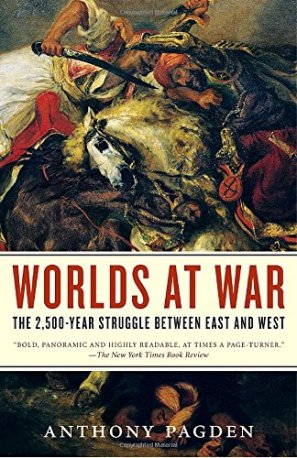
For a deeper look at the underpinnings and logic behind this worldview, Anthony Pagden’s ‘Worlds at War: The 2,500-Year Struggle Between East and West’ (Penguin-Random House, 2008) gives an in-depth analysis of the history behind this concept (and offers a cautionary tale on pursuing this line of thought). The book explores the belief that the Muslim world and the West can not co-exist: that Western civilization prioritizes rational thought, individual liberty, and secularism, while the Islamic world and its culture are backwards, fundamentalist and constrained by adherence to a vacuous, immoral belief system – and that they are forever doomed to conflict until one side or the other eventually triumphs completely.
Adherents to the ‘clash of cultures’ worldview are stumbling all over the facts in order to justify their beliefs. Influential national security figures in the upcoming administration insinuate that not just jihadis, but that average Muslims, are a threat lurking within our midst. Conservative social media users traffic in made-up stories about historical suppression of Islamic terrorism through desecrating the bodies of insurgents. The iconography and language of the Crusades has taken a hold on the so-called Alt-Right, and the influential soon-to-be public servants who are allied with them. Conservative leaning “news” outlets routinely push debatable claims about Muslims working to subvert American and Western culture and implement Sharia law in the US.
This view of Islam itself as being some sort of pernicious global enemy, and the fear inspired by the campaigns of global terror networks, have lead adherents of this belief system to begin casting about for allies. When viewing geopolitics through that lens, as it seems many Republicans (and indeed, many Americans in general) now do, Russia begins to look appealing as an ally to combat Islamic jihadist terror.
Conservatives on social media have been enamored of Vladimir Putin for a few years, sharing stories, false statements and projecting their own fantasies about his militant approach to combating terrorism in Russia, including one particularly bellicose (and completely mis-attributed) quote from the Russian leader that states: “I swear if they bomb Russia, in half an hour every Muslim will die.” As the handler of the Twitter account Deplorable Pamski put it, “And this is why we like Putin over Obama. He is a leader protecting his people [sic].
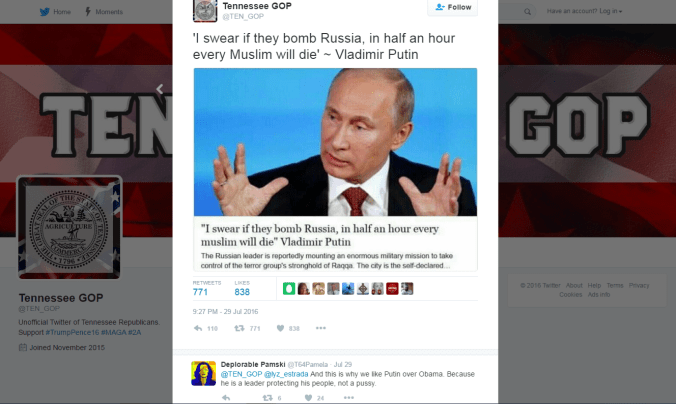
Spoiler: Vladimir Putin never actually said this (Note: The Twitter account captured in this photo has since been exposed as tied to the Russian troll farm Internet Research Agency, in St. Petersburg; it is not from Tennessee Republicans)
Stories about the heroism of Russian troops fighting ISIS have made the rounds in the media as well, including one about the ‘Russian Rambo,’ Spetznas Lieutenant Alexander Prokhorenko, who called in airstrikes on himself to destroy the ISIS fighters who were overrunning his position. Alt-right websites parrot Russia Today (now RT) talking-points, creating the impression that Russia is deeply involved in a war against global terrorists, when it is actually involved in a war against anti-Assad rebels in Syria (some of whom happen to be Islamist militants). The anti-terrorism rhetoric employed by Russia (as well as its allies, Iran and the Assad regime) has provided a legitimizing smokescreen that has allowed it to get away with systematically destroying hospitals, bombing aid convoys, and intentionally targeting civilians with airstrikes, in order to support its ally against forces sponsored by the United States. Putin and the Kremlin have portrayed an almost religious fervor in their mission to destroy ‘terrorists’ in Syria. The alt-right, as well as nationalist groups in Europe, have taken notice.

Alt-right image portraying Marine Le Pen, Donald Trump and Vladimir Putin as Crusaders
What is the take away from all of this? One could infer that a receptive American audience consisting of religious conservatives, alt-right nationalists, and people afraid of Islamist terrorism, have latched onto a misleading narrative (driven by Kremlin propaganda) of a war for the very survival of the West, which can only be saved by the intervention of strong leaders who put the needs of their own citizens first. To be frank, the facts show that terrorism is less of a threat than many realize. The 2011 Report on Terrorism from the National Counter Terrorism Center notes that Americans are just as likely to be “crushed to death by their televisions or furniture each year” as they are to be killed by terrorists.
This irrational fear of terrorism, and the actions it is provoking in order to keep Americans safe – insofar as it stokes Islamophobic and anti-Muslim violence, and causes us to pull away from our allies in the Middle East and greater Islamic world- makes America less safe. Our intelligence agencies, which have a well-known lack of speakers of the languages in which transnational terror networks communicate, rely on the intelligence collected on the ground by our allies in the region. Our military relies on bases in the region in order to conduct actions to disrupt and destroy terror networks that operate from the Middle East, including ISIS and al-Qaeda.
In regards to Russia, it is important to note: there is nothing inherently wrong with better relations with Moscow. Every President since Bill Clinton has attempted to normalize relations with the Kremlin- albeit on our terms. Russia could indeed be a valuable partner in tackling issues from combating global terrorism to nuclear-proliferation, and in improving security in vast regions of Europe, the Middle East and Central Asia. A working relationship with the Kremlin in those limited areas, while firmly reiterating a commitment to human rights and an insistence that Russia adhere to global norms of international relations, could bear many positive fruits.
However, from a geopolitical standpoint, those enamored of Russia must remember that our objectives are vastly different. Russia’s (or more accurately, Vladimir Putin’s) objective is to return to the world stage as a major power, and with that comes the necessity to dominate large swathes of the Eurasian land mass, which would give its fleets friendly ports in which to refuel, and make it less vulnerable to attack from the maritime power of competitors on other continents (such as the United States). Russia seeks to undermine NATO, as they rightly believe that a strong NATO undermines Russian ability to project influence into Eastern Europe. It also seeks to neutralize the European Union, which would give it more access to markets in which to sell the by-products of its natural resource driven economy.
Conversely, the United States sits at the head of the very NATO alliance that Russia seeks to undermine. Through NATO, America is able to guarantee the security of its allies in Europe, through which it can then project power into Eastern Europe, the Middle East, and North Africa. A strong NATO and European Union allow the US to have great influence on the conduct of European affairs, as well as making Americans at home more safe through interagency and multinational counter terrorism efforts. Let us not forget that the terrorists who committed the attacks on 9-11, also known as the ‘Hamburg cell,’ lived in Germany and plotted the attack there. A stronger, more united and cooperative European Union can help prevent the next major attack that could be plotted in a more disunited continent.
Lastly, George Friedman of Stratfor writes: “America is in the position of Great Britain in the 19th century. Its national interests are served by maintaining a policy that balances powers off against each other. U.S. interest is not to have a global peer power. As long as that does not happen, the U.S. can make as many mistakes as it wants. If a global peer power does emerge, the world gets much more dangerous.”
Any so-called alliance with a nation that seeks to grow its own influence at the expense of the United States will never be a full partner. A more powerful Russia will not make America safer, at least in the current way in which Russia seeks to re-emerge from its humiliating post-Cold War rut. American power depends on strong markets and alliances in Europe and Asia, freedom of navigation of the seas globally, and the ability to project force into Eurasia in order to pursue its security objectives.
Any practitioner of foreign policy who forgets those simple geopolitical rules will make America less safe, less prosperous, and less independent to pursue its geopolitical aims.
Note on sources: Where Russian sources such as ‘Sputnik’ and ‘Russia Today’ are cited, it is in order to give voice to the Russian perspectives on global affairs.
Sources which bear the preface ‘Alt-right’ are not intended to legitimize the information presented therein, but to give the reader a first-hand perspective on what is said online outside of the scope of larger media sources.
 Twilit Empire