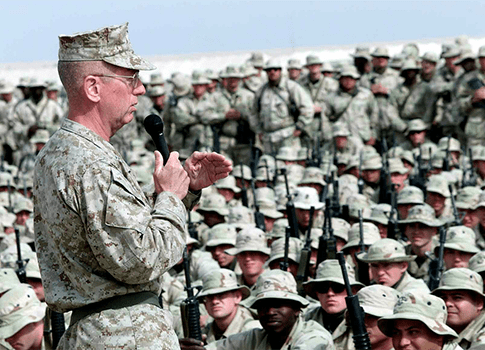
Well, it goes without saying that part of me is extremely excited about the nomination of General Mattis for Secretary of Defense. As a Marine, and particularly as an infantryman, I can’t help but feel proud that the finest officer to wear the Eagle, Globe and Anchor since Chesty Puller has been nominated to head the Pentagon, and manage America’s military. However, though I’m sure many of my fellow Devil Dogs will NOT agree, I must say that I have my reservations as well. Let me explain:
I’ll start with the excited part: Mattis is a living legend to my generation of Marines. His no-nonsense way of speaking has endeared him to the enlisted ranks, who generally express themselves in a similar (if often less eloquent) way. Throughout his 34 year career, Mattis has held many prominent combat commands – most famously as CG of the storied First Marine Division in Iraq in 2003 – as well as leading US Joint Forces Command and US Central Command (CentCom). He played a prominent role in *Operation Phantom Fury, which is now enshrined in Marine Corps history and legend alongside battles such as Tripoli, Chapultepec, Belleau Wood, Iwo Jima and Hue City. Mattis earned a reputation throughout for decisiveness, tactical brilliance, and dedication to his Marines.
All of that is enough to satisfy most people, but where Mattis truly shines is in his lifelong commitment to continuing education, and his rigorous study of history, strategy and policy. Though he is more well-known by the nickname “Mad Dog” (which he apparently isn’t crazy about), he is also referred to as the “Warrior Monk.” This comes from his claims to own 7,000 books, and from the fact he told the Marines invading Iraq to “engage your brain before you engage your weapon.” The Marine Corps has seldom been known as an incubator of great scholars, and that is what sets Mattis above and apart from his peers.
From a political standpoint, many of you are aware of my reservations about the current President-elect. Considering Donald Trump doesn’t read, routinely ignores (or doesn’t attend) foreign policy briefings, regularly questions the continued necessity of NATO and other alliances, and has nominated a General with questionable beliefs about Islam to be his National Security Advisor, I believe someone with Mattis’ deep experience working with Middle-Eastern allies, and propensity towards deep analysis, would be a valuable counterbalance when it comes to foreign policy decisions in a Trump administration.
Now for the Reservations: I’ll leave it to Jim Garamone from DoD News to express a few fundamental truths about civilian control of the military:
“When they wrote the Constitution [the Framers] separated the responsibilities for the military, placing the responsibilities firmly in civilian hands.
Article I, Section 8 of the Constitution states that Congress shall have the power “to raise and support Armies …” and “to provide and maintain a Navy.” In addition, Congress must provide for the state militias when they are called to federal service.
Article II, Section 2 states, “The President shall be the Commander in Chief of the Army and Navy of the United States, and of the Militia of the several States when called into the actual Service of the United States.”
Congress has the power to declare war and to make the rules for governing the military.
So the framers spread responsibilities for the military around. The president and Congress had to work together to use the military.”
Jim wrote this in May, 2001, so if to the reader it seems to bear little resemblance to the way the President can authorize military force today, that’s because it doesn’t. A decade and a half of undeclared war against the nebulous forces of terrorism has completely eroded Congress’ say in when, where and even if US military forces deploy to combat missions abroad. Both George W. Bush and Barack Obama, through executive orders and other means, have leveraged the result and threat of terrorism to expand the scope of US military presence and action so extensively that people literally can’t figure out how many wars we are fighting.
All this brings us to the unprecedented challenge confronting the foreign policy community today: an impulsive President-elect (soon to be Pres), surrounded by former Generals, with the world’s most powerful military at his disposal, and no Congressional oversight (or worse, both Houses of Congress controlled by said President’s party) as to how it is used.
So my concern is not about James Mattis at SecDef, per se, but rather the fact that, when you only have a hammer, every problem starts to look like a nail. Mattis has only been out of uniform for 3 years, and will require a special waiver from Congress to be approved for the position. For all of his wisdom, foresight and introspection, Mattis has essentially no training in looking at the world through the lens of a civilian.
My other concern is about precedent: even though Mattis is an able, and even excellent choice for the Cabinet position, what happens if he and President Trump have a falling out? I can’t think of two less intellectually similar leaders, and don’t put a Mattis resignation outside the realm of possibility. What then? What new General can be summarily approved by Congress to fill the post? Someone more inclined to agree with Trump, Flynn and John Kelly?
In summation: I have extremely mixed feelings about the appointment. I think Mattis would be an excellent counter-balance to the worst inclinations of Trump and Flynn, but my concerns are primarily related to what comes after. The erosion of the principal of civilian control of the military is enshrined in our Constitution, and is a fundamental pillar of liberal democracy. It may be that we gain a wonderful Secretary of Defense in the present, and erode the Constitutional nature of our government in the future.
Just this Marine’s $0.02
 Twilit Empire