Many of you have asked me about the cover photo for this blog, and I think an explanation is owed, due to the abstractness of the photo and the reasons behind its selection. I picked it for a blend of personal, thematic and aesthetic reasons.
In 2009, I was a student at the Institute for American Universities in Aix-en-Provence, France, studying abroad through Towson University. Though my course of study focused primarily on European literature, history of the Resistance, and French language courses, many of my fellow American students were enrolled at the prestigious Marchutz School of Fine Arts, and I was talked into (last-minute) enrolling in a 300-level Art History course concentrating on the works of Paul Cézanne and Vincent Van Gogh; both of whom had deep roots in Provence.
Cézanne lived, worked and died in Aix. His landscapes often featured the Mont Sainte-Victoire, a limestone ridge jutting up from rolling valleys and hills of the Bouches-du-Rhône, and which I could almost see from my little room in a house on the Crèche Pin d’Epices (“nursery of spice pines,” as best I can translate). I walked past the house where he died on Rue Boulegon every day on my way to classes in the old reclaimed priory that housed the IAU classrooms and offices. We drank coffee and pastis at the Brasserie Les Deux Garçons where Cézanne and Émile Zola met to discuss their works over 100 years prior. Cézanne’s shadow was everywhere no matter where I went in Aix.
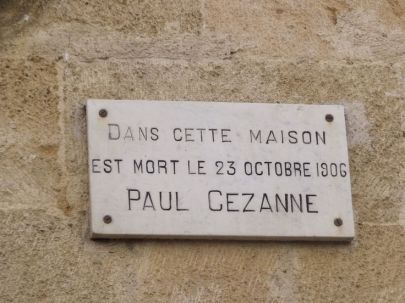
23 Rue Boulegon: “Paul Cezanne died in this house, October 23 1906”
Less omnipresent, but perhaps more haunting, was the legacy that Vincent Van Gogh left on Provence. As an artist, Van Gogh was given to deep fits of melancholy, substance abuse, and erratic behaviors. Though much of his most recognizable work was done in Provence, it was done at a time when he was deeply hurting. ‘Café Terrace at Night’ was done during or immediately after the nine weeks he shared an apartment with Paul Gauguin, which period ended with Gauguin drunkenly cutting off Van Gogh’s ear with a cavalry saber after an absinthe binge and then fleeing to Tahiti. His famous ‘Starry Night’ painting was the view from his room at the asylum to which he was committed at Saint-Rémy-de-Provence. Released in December, 1889, he would be dead by his own hand in a field in Auvers-sur-Oise, near Paris, less than a year later.

‘Cafe Terrace at Night,’ Vincent van Gogh, 1888
John Gasparach, the professor who taught the course, had us tramp through fields, over bridges, and through many woods and vinyards as we traced the footsteps of the two great Provençal painters. We sat where they sat, saw what they saw, and sketched what they painted. We visited studios, homes and asylums, trying to get inside the heads of the artists.
Our wanderings took us one spring day to the Alyscamps, an ancient Roman necropolis outside the old city of Arles. Van Gogh and Gauguin had done a number of different paintings of the old sarcophagi and the cracked flagstones of the Via Aurelia that led all the way back to Rome. While my fellow students, mostly artists, sat down in the cool shade beneath the rows of Cypress trees to begin sketching the scene, I was feeling too contemplative to (badly) draw.
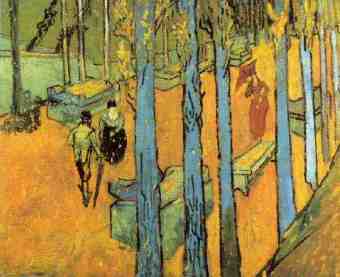
‘Les Alyscamps, falling leaves,’ Vincent Van Gogh, 1888
As a student of history, I have always been fascinated by the empires and civilizations of the past. Though there have been many empires, none looms as large as the shadow of Rome, and none has been so often compared to our political experiment here in America.
2009 was a much different time to be an American than 2016, and particularly abroad (when I was in London just this past month, I can’t tell you how many folks asked me concernedly “what’s the deal with Trump??”). Barack Obama had just been elected a few months prior, and there was a feeling of hope and change in the air. People were hoping the wars in the Middle East would wind down, that the free exchange of people and ideas would accelerate. The Bush years were behind us… surely this was a new dawn for America, and the world.
And yet here I was, confronted with the endless line of graves of those Romans who must have felt similarly before their own world crumbled to dust. How could they have ever imagined what would come after, what was taking place at that very moment: that a young man from a continent they didn’t even know existed might one day stand by their ancient, ransacked tombs and contemplate the fleeting nature of the civilization in which he lived.
Rome has always been associated with its pageantry, its monuments, its victories. And yet, they were uniquely aware of the temporal nature of all empires. When their generals, triumphant in war, paraded through the streets of Rome with their conquered enemies in chains, the wealth of plundered nations housed in their massive temples, they were escorted by a slave who’s job it was to whisper in the victorious commander’s ear: “Sic transit gloria mundi” – “thus passes the glory of the world.”
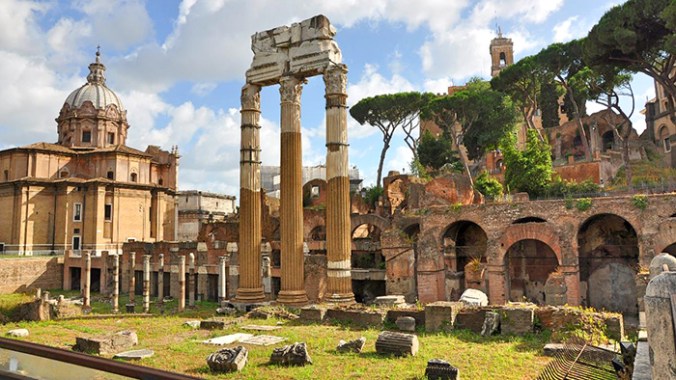
Roman ruins: photo credit to Davidsbeenhere.com
When I named this blog, that phrase rang in my ears. I think it is clear for all to see that even though America is still a super power, it is a titan in decline. The unipolar world of the 1990’s, the world that followed the end of the Cold War where America reigned triumphant as the sole superpower, has been succeeded by a world of of multipolarity, competing centers of power and influence- a “G-Zero world” to quote Ian Bremmer. It is a world full of challenges to American power and influence; of hybrid wars and cyber attacks; of terrorists and autocrats masquerading as representatives of their people; of technology and automation driving revolution and inequality.
And yet is also a world full of new opportunities for America… billions have been lifted from poverty, free to pursue their economic destiny; a network of global alliances still ensure peace on large portions of the earth’s surface; literacy rates and education enfranchise millions more each year across the globe; and trade and the exchange of people and ideas, connected by communications technologies, bring us ever closer together as a species.
We stand at the crux of history, as the Romans once did as well over a thousand years ago. Will we embrace the changing nature of the world, and continue to lead, to expand our influence and extend the Pax Americana to more nations and peoples, or will we retreat behind our oceans while the world moves along without us? After all, Rome still exists… albeit as a city, one of dozens of other capitals in Europe, a city of relics and tombs and temples, and monuments to past glory, gathering dust and memories, having given way to the tides of history.
 Twilit Empire