“Turning and turning in the widening gyre
The falcon cannot hear the falconer;
Things fall apart; the centre cannot hold”
-W.B. Yeats, ‘The Second Coming’
Park Plaza Victoria, London: The sun set on the British Empire a long time ago, but the legacy of colonialism and imperialism appear to still be rocking the United Kingdom to its very core. Ever since the rather tight referendum whereby Scotland almost left the UK, Britons have been more vocally questioning their place in the wider world… and it seems they have found their answer: they don’t really want much to do with it at all.
I’m in London on business to participate in the Telegraph’s cyber security series, filming a spot with the CEO of my company for the conference in November. We’ve had busy days, but in the evenings I have been taking advantage of the London evening scene. There’s a particularly charming little corner pub two blocks from the hotel where I’ve been passing my spare time after business hours: The Prince of Wales.

The Prince of Wales Pub, Victoria
It’s a venerable old establishment, with a crowd of regular local patrons mixed with the foreign crowd that stay at the large hotels nearby, clustered about Victoria Station. The food is good, the beer isn’t quite as cold as Americans are used to, and the people are friendly. People seem genuinely pleased to meet a Yank and we have had plenty to talk about, what with the recent referendum and our own impending elections.
While these discussions were in no way rigorous or scientific, they gave me some interesting insights into what the mood is in the country, and the motives of both those who voted for, and against, Brexit. These conversations caused spirited debates within the pub, leading me to believe that even though the votes have been tallied, the issue has not been truly laid to rest.
Ralph (not his real name), a middle-aged Brit who works 6 months a year in Norway as a mechanic on NATO combat aircraft through a transnational defense contracting firm, surprised me by how pro-Brexit he was. As a person who depends on international cooperation agreements and NATO for his livelihood, I was expecting him to be a “remain” voter. However, his feeling was that the UK was losing it’s sovereignty, becoming beholden to dictates from Brussels. He also raised the complaint that immigrants – whether it was Poles and other Eastern European migrant laborers undercutting the wages of native workers, or the large and growing populations of South Asians concentrating in large cities such as London – were changing something essential about both the economy, and (seemingly more important to him) the essential character of what it means to be British. Many patrons at the Prince of Wales echoed his sentiments.

L’etranger: French-Japanese fusion in Kensington
Moving on from Ralph’s (primarily ethnically motivated) arguments, I found myself having a conversation with Stephen (also not his real name) over drinks and dinner in Kensington. Stephen was another one that I would have expected to vote to remain in the EU; he was head of international sales at a technology analysis and research firm for 20-odd years, and had spent the better part of his life on planes, trains and automobiles throughout India, East Asia, Australia and Latin America. He has a deep understanding of the interconnectedness of the modern global economy, both from a communications infrastructure perspective, as well as from the perspective of a business leader who knows that a UK-based company can have a team of research scientists based in Switzerland, programmers based in India, and manufacturing facilities in Hong Kong, yet still employ hundreds of British citizens.
The restaurant we sat in, L’etranger (Fr: ‘the stranger’), is itself the very model of cosmopolitan multiculturalism that Brexit (and certain strains of the American electorate) seems to stand in opposition to: named for an absurdist, existentialist novel by the French philosopher Camus; the menu a mélange of Japanese and French cuisines; a wine list curated from vineyards across Europe, as well as Latin America, Australia and Africa; all run by an Algerian immigrant with a master’s degree from the Sorbonne named Ibi Issolah.
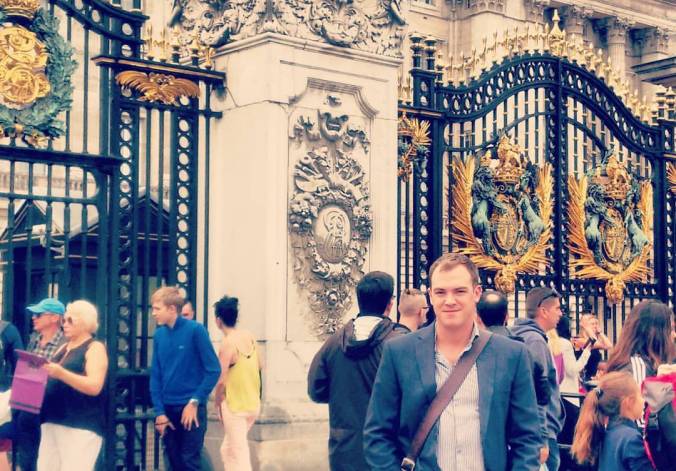
Buckingham Palace
As I munched on confit Welsh lamb shoulder with miso glaze, sipping Suntory Hakushu 12 year Japanese whisky at the bar, I listened bemusedly as Stephen explained to me the benefits of Brexit in his refined “Oxford English” accent. He was one of those voters, he told me, who pulled the lever for Brexit “even though we never thought it would pass muster.” He confided in me that Brexit was something that many wanted in private, but that no one discussed in public, due to the connotations of racism, xenophobia and bigotry that it carried. “It’s not a proper thing to say over supper,” he conspiratorially whispered. “Even today.”
Stephen’s case for Brexit is very much a reflection of his labor category; that is, Stephen used the language of economics and trade to verbalize his opposition to the EU. He believes that by leaving the Common Market, the UK will have more freedom to engage in, as well as renegotiate, trade deals that are more favorable to British businesses and workers. He rejects the notion that Brexit was primarily motivated by protectionism and nativism, and instead stresses that the referendum was more about asserting the UK’s independence and freedom to act on the global stage.
I sipped my whisky, staring out the window at the evening crowds passing by in the light rain beneath streetlamps, trying to wrap my head around the contradictions and arguments underlying Brexit voters’ motivations.
*
Though the British Empire may seem to most a thing of the distant past, it only officially ended in 1997, when Hong Kong was transferred back to Chinese control. Britain’s oversees possessions, and the administration thereof, informed domestic and foreign policy for over 400 years. Vast swathes of the planet lived under British Imperial rule, on all six inhabitable continents.

The British Empire in the 1920’s
The first wave of decolonisation (pursued with encouragement from anti-colonialist policy by the United States) released large amounts of territory from Imperial control. In 1947, India declared its independence, and almost immediately partitioned itself into the competing states of India and Pakistan. The British Mandate in Palestine was overturned by Jewish settlers, and the state of Israel was declared in 1948. A revolution pushed the British from power in Egypt in 1952. A further wave of decolonisation swept the UK’s African holdings in the 1960’s.
Modern mass immigration to the UK roughly coincided with the end of WWII and the rapid decline of the Empire which immediately followed. Though initially the British government courted and admitted Poles and other European refugees fleeing the horrors of the war and the Soviet takeover of Eastern European, immigration soon took a more post-colonial turn, as large populations of Afro-Caribbeans, Indians, Pakistanis and populations from the British imperial holdings in Africa moved into the island nation. As well, nearly 10% of the population of the UK is Irish, as successive waves fled Ireland failing periodic turmoil such as the crop failures of the 1840s, the struggle for Irish independence in the 19-teens and 20’s, and the Troubles coming from British imperial conflicts in Northern Ireland.
In short, the historical migrations from the island to the colonies had reversed, and the movement now worked in the opposite direction. The legacy of Empire had come home, so to speak, and it seems the native Britons have become rather disillusioned.
So what will Brexit mean for the UK? If trends toward decentralization (represented by decisions like Brexit) continue on the Continent, it is easy to foresee a dissolution of the European Union. Leaders across the continent, from Marine Le Pen in France to Norbert Hofer are campaigning as anti-globalization, pro-nationalism candidates. Far-right, nationalist parties have representation in nearly every country in Europe, and appear to be gaining ground, most notably in France and Austria.
In the near term, Britain will have to renegotiate entrance into the common EU market. There are differing views over what economic impact Brexit will have on the UK economy, but what most serious observers can agree on is that, essentially, no one has any idea. It’s uncharted territory. History over the last 200 years has been essentially a story of creating larger and more integrated common markets. Brexit, and the economic nationalism espoused by other far-right candidates (and Donald Trump in the US elections) hearkens back to a much older model for which we don’t really have a modern example.
Geopolitically, Brexit will mean one of two things for Europe – both of which are destabilizing. Historically, Britain has played the counter balance to both Germany and France, working to prevent both from gaining hegemony in Europe (ref: Napoleonic Wars; World Wars 1 & 2).
The first possibility is that, with Britain effectively gone from Continental politics, France and Germany are left as the two largest economies in Europe, with the most to gain from competition with one another. Competition between these two nations has had a turbulent history, and one which could shake Europe to its very core if left unchecked.
Second, France and Germany may decide to further cooperate, growing their economies and international prestige at the expense of Britain, and leaving the UK sidelined and without a seat at the table while major decisions with massive repercussions for the UK are made. The threat here to US interests is that, without Britain (and its historically pro-US perspective) providing input on these major decisions, US interests are left out, and leaving Europe to become more insular.
A decisive, internationalist Europe has been a great aid to US foreign policy in the post-war period. European soldiers, sailors and airmen have fought beside US forces in conflicts as diverse as Korea, Vietnam, Iraq, Afghanistan, Libya and Syria. A United Europe also acts as a counter-balance to Russian influence in Europe. Were Germany and France to move closer into one another’s orbits, Britain would more than likely seek to foster closer ties with Russia to counterbalance Franco-German dominance on the continent (generally not in-line with US interest).
The implications of the weakening of the EU (with its inevitable consequences for NATO) would spell grave difficulties for both Europe and the United States. Brexit would embolden Vladimir Putin’s resurgent Russia, and complicate cooperative security challenges to the continent, such as counter-terrorism and the migrant crisis. While the Brexiteers are celebrating today, they must acknowledge they are leading their country – as well as the rest of Europe – down a path of increasing instability, with no light at the end of the tunnel that is visible to anyone observing today.
 Twilit Empire